The Evolution of Flight: Understanding Fixed-Wing VTOL Drones
In the rapidly shifting landscape of unmanned aerial vehicles (UAVs), Fixed-Wing VTOL drones stand out as a masterclass in aeronautical engineering. By successfully merging the vertical agility of a multi-rotor with the high-speed efficiency of a traditional airplane, these hybrid machines have redefined what is possible in the skies. Whether it is navigating the tight corridors of an urban delivery route or conducting long-range industrial surveillance, the fixed-wing VTOL is the ultimate “no-compromise” solution for modern industry.
What Exactly is a Fixed-Wing VTOL Drone?
VTOL stands for Vertical Take-Off and Landing. Traditionally, pilots had to choose: the ability to hover in tight spaces (rotary-wing) or the ability to fly fast and far (fixed-wing).
A Fixed-Wing VTOL eliminates this trade-off. It utilizes rotors to lift off the ground like a helicopter—requiring zero runway space—and then tilts its motors or uses a secondary propulsion system to transition into forward, wing-borne flight. This transition allows the drone to utilize lift generated by its wings, which is far more energy-efficient than constant rotor spinning.
Powering the Hybrid Revolution
How do you keep such a versatile machine in the air? The propulsion choice usually depends on the mission’s scale:
-
Pure Electric: Ideal for silent, eco-friendly operations. These rely on high-capacity battery packs.
-
Hybrid-Electric: A game-changer for endurance. A small internal combustion engine acts as an onboard generator, charging the batteries while the drone is in flight.
-
Alternative Energy: High-tech frontiers now include Hydrogen Fuel Cells for zero-emission long-distance travel and Solar Arrays integrated into the wing surface to trickle-charge the system during daylight.
Categorizing VTOL Performance
Not all VTOLs are created equal. Depending on the airframe and power source, they fall into three main specialized categories:
1. Long-Range & Endurance
While standard electric drones might struggle to cross a small county, Long-Range VTOLs (especially hybrids) can cover between 80 to 320 km (50–200 miles). When a drone can stay airborne for more than 4 hours, it enters the “Long Endurance” class, making it perfect for border patrol or environmental tracking.
2. Heavy Load Carriers
Industrial-grade VTOLs are built with reinforced airframes to handle “Heavy Loads”—typically defined as a payload of 25 kg (55 lbs) or more. Some advanced hybrid models are now capable of hauling over 50 kg, bridging the gap between small drones and manned cargo aircraft.
The Heart of the Machine: Choosing Your Battery
For an electric fixed-wing VTOL, the battery is the most critical component. You need a “Goldilocks” solution: enough capacity to stay in the air, but low enough weight to actually get off the ground.
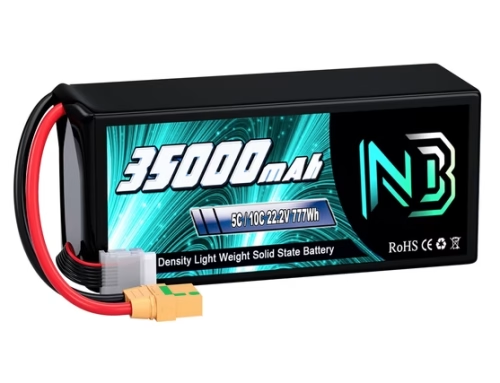
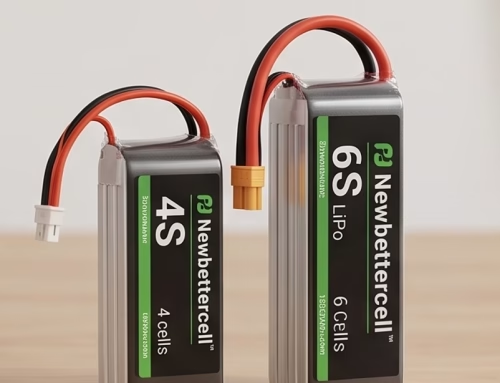
This is where energy density becomes the deciding factor. Newbattercell is leading this charge with a specialized semi-solid state battery that pushes the boundaries of drone performance.
Why Newbattercell Semi-Solid State Technology?
Standard LiPo batteries often hit a ceiling in terms of weight-to-power ratios. Newbattercell has shattered that ceiling with technology offering:
-
Massive Energy Density: Up to 320 Wh/kg, allowing for significantly lighter packs with more “juice.”
-
Versatile Voltage: Supporting configurations from 6S to 14S, fitting everything from nimble scouts to heavy-lift giants.
-
High Capacity: With options reaching 84 Ah, these packs provide the sustained current required for the grueling transition from vertical hover to horizontal cruise.
Whether you are designing a drone for long-distance logistics or high-stakes mapping, the power source from Newbattercell ensures your hardware isn’t just flying—it’s outperforming the competition.