In the high-stakes arena of professional FPV racing and elite-tier aerial cinematography, the bottleneck for performance is rarely the motor or the ESC—it is the power source. This technical guide explores the engineering intricacies of high C-rate LiPo battery customization, providing engineers and procurement managers with a blueprint for superior power delivery. You will learn how high discharge rate cell formulation impacts voltage stability, why custom drone battery dimensions are critical for center-of-gravity (CG) optimization, and how high-rate battery pack assembly protocols ensure reliability under extreme thermal stress. As a specialized OEM FPV drone battery manufacturer, Newbettercell provides the precision engineering required to transition from generic power to bespoke performance.
Key Takeaways:
- Voltage Stability: Custom electrolyte additives reduce internal resistance, preventing sag during 120C+ bursts.
- Physical Integration: Bespoke cell dimensions maximize mAh capacity within specific frame constraints without adding parasitic weight.
- Thermal Management: Advanced tab design and heavy-gauge wiring are essential for handling 200A+ peak currents safely.
Beyond Standard Off-the-Shelf Power: The Case for Customization
For professional FPV pilots and industrial UAV designers, off-the-shelf batteries represent a compromise. Standard packs are designed for a broad average of users, often sacrificing peak discharge capability for shelf-life or manufacturing cost. In competitive racing, even a 0.2V drop in sag during a punch-out can be the difference between clearing a gate and a catastrophic crash. High C-rate LiPo battery customization allows for the fine-tuning of every component, from the molecular structure of the anode to the specific gauge of the discharge lead.
Newbettercell operates as a premier OEM FPV drone battery manufacturer, moving beyond the “one-size-fits-all” approach. We recognize that a 5-inch racing quad has vastly different power requirements than a 7-inch long-range cinematic rig. By engaging in custom LiPo battery pack design, manufacturers can specify the exact balance of energy density and discharge rate needed for their specific airframe and motor KV rating. This intent-first approach to power ensures that the battery is an integrated component of the drone’s flight dynamics, rather than an afterthought.
How can custom cell formulations eliminate voltage sag?
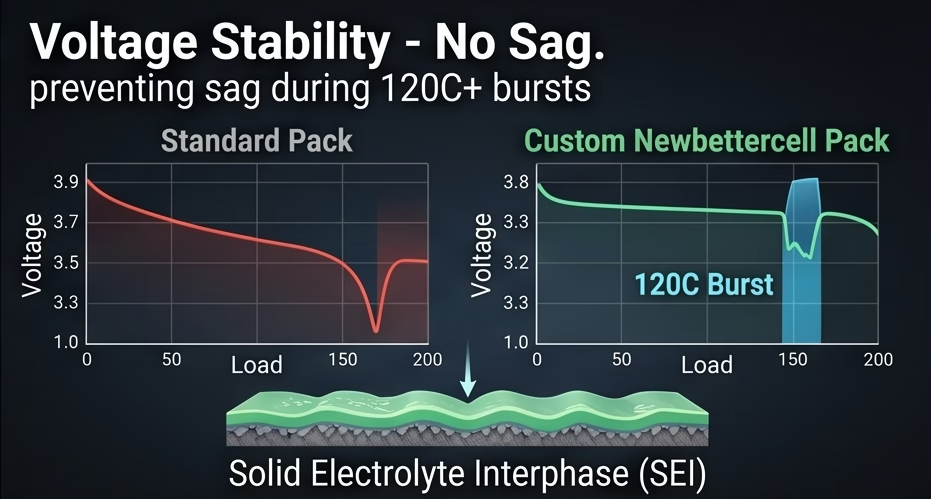
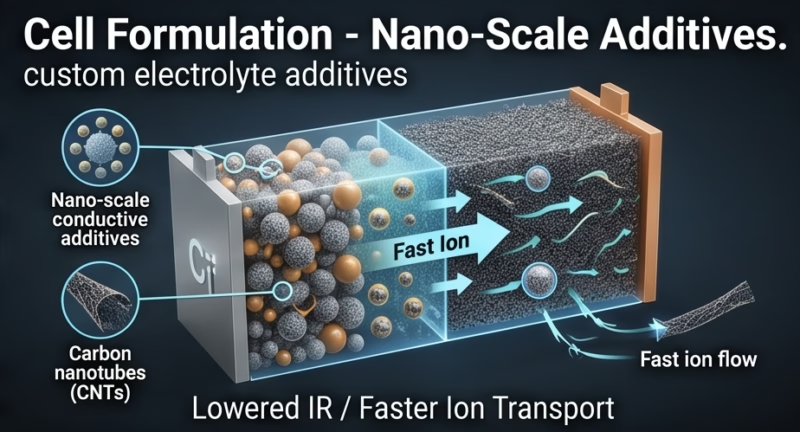
The foundation of any high-performance battery is its chemistry. To achieve a true 100C or 120C continuous discharge, a standard Lithium Cobalt Oxide (LCO) formulation is insufficient. At Newbettercell, our high discharge rate cell formulation involves a precise blend of materials designed to facilitate rapid ion transport. We utilize nano-scale conductive additives in the cathode and specialized carbon nanotubes (CNTs) in the anode to lower the overall impedance of the cell.
Voltage sag is primarily a function of Internal Resistance (IR). When a high load is applied, the chemical reaction within the cell must occur fast enough to supply electrons to the external circuit. If the ion mobility is restricted, the voltage drops. Through high C-rate LiPo battery customization, we can adjust the electrolyte concentration and include additives like Fluoroethylene Carbonate (FEC) to improve the stability of the Solid Electrolyte Interphase (SEI) layer. This chemical engineering ensures that Newbettercell premium LiPo packs maintain a flatter discharge curve even when the pilot demands 100% throttle.
Furthermore, the thickness of the electrode coating plays a pivotal role. Thinner coatings allow for faster ion diffusion, which is essential for high C-rates, though it slightly reduces total energy density. A professional FPV racing battery supplier must balance these trade-offs based on the client’s specific flight duration and power-to-weight targets. By customizing the loading level of the active material, we can optimize the cell for the 2-to-3-minute sprints typical of FPV racing.
Can custom dimensions improve drone flight dynamics?
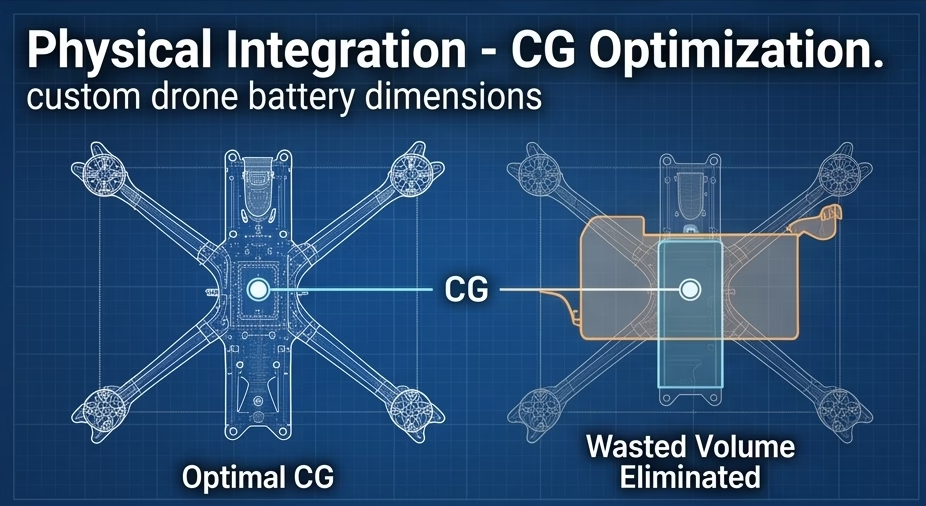
In drone design, space is the ultimate premium. Standard batteries often force designers to build frames around the battery, leading to sub-optimal aerodynamics or imbalanced weight distribution. Custom drone battery dimensions allow engineers to specify the length, width, and height of the cell stack to the millimeter. This flexibility is vital for maintaining a tight Center of Gravity (CG), which directly affects the PID tuning and flight feel of the aircraft.
For instance, a low-profile, wider pack can lower the CG on a top-mount racing frame, reducing the moment of inertia and allowing for snappier rolls and more precise cornering. Newbettercell’s ODM capabilities allow for the creation of “long” or “square” configurations that fit perfectly within the carbon fiber side plates of modern X-frames. This level of custom LiPo battery pack design ensures that no volume is wasted, allowing for a higher mAh capacity within the same physical footprint.
Weight optimization is the second half of the dimensional equation. By utilizing high-energy-density materials and minimizing excess packaging, we can reduce the overall mass of the pack. In the world of professional FPV, every gram removed is a gram that doesn’t have to be accelerated by the motors, directly translating to increased agility and reduced motor heat. Our engineering team works closely with UAV designers to ensure that the final battery dimensions contribute to the aerodynamic efficiency of the craft.
Why do tab design and connectors dictate current delivery?
A high-performance cell is useless if the energy cannot be extracted efficiently. The interface between the internal cell chemistry and the external wiring—the tabs—is a frequent point of failure in high-rate applications. Standard tabs are often made of thin nickel or aluminum, which can become a bottleneck and generate excessive heat at high currents. In our high-rate battery pack assembly process, we utilize thickened, pure copper tabs with specialized ultrasonic welding techniques to ensure a low-resistance connection.
The choice of wiring and connectors is equally critical. For a professional FPV racing battery supplier, providing a custom XT60 drone battery or an XT90 variant is more than just a matter of plug compatibility. It involves selecting the correct wire gauge—typically 10AWG or 12AWG for racing—to prevent the wires from acting as resistors. Excessively long leads add unnecessary resistance and weight; therefore, customization includes specifying the exact lead length to reach the ESC without excess slack.
Internal Resistance (IR) matching is the final step in the assembly process. Even cells from the same production batch can have slight variances in IR. To create a high-quality pack, we perform precision grading to group cells with nearly identical resistance and capacity. This ensures that all cells in a 4S or 6S pack discharge at the same rate, preventing one cell from over-discharging or overheating, which is the primary cause of premature pack failure in high-stress environments.
How does precision grading ensure fleet reliability?
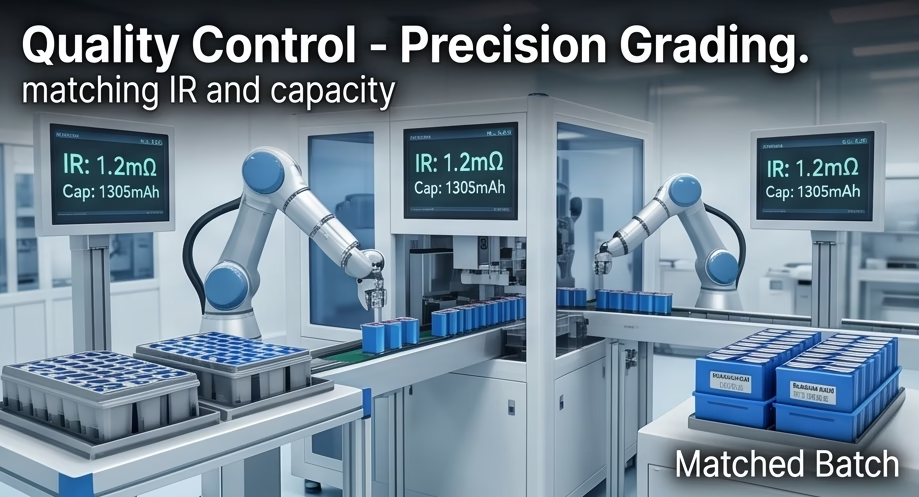
For B2B buyers and commercial UAV fleet operators, reliability is as important as peak performance. A single battery failure can result in the loss of an expensive airframe or a missed shot on a high-budget film set. Our quality control protocol involves rigorous cycle-life testing and thermal imaging under load to ensure that every customized pack meets the specified C-rate without exceeding safe temperature thresholds. This data-driven approach is what defines a professional FPV racing battery supplier.
Compliance with global safety and transport regulations is non-negotiable for bulk sourcing. All Newbettercell products undergo testing to meet international standards for secondary lithium cells, including UN38.3, MSDS, and CE certifications. These standards verify that the batteries can withstand the rigors of transport and high-intensity use without risk of fire or explosion. For global distributors, this compliance simplifies the logistics of cross-border shipping and ensures that the end-user receives a safe, high-performance product.
Furthermore, we implement a serial tracking system for every custom pack. This allows for full traceability of the materials and the assembly technicians involved. In the rare event of a performance discrepancy, this data allows us to identify the root cause and refine the manufacturing process. This commitment to transparency and engineering excellence is why Newbettercell remains a trusted partner for the world’s most demanding FPV and UAV applications.
Elevating a drone from a recreational toy to a high-performance racing machine requires a holistic approach to power management. By focusing on high C-rate LiPo battery customization, OEM manufacturers can unlock the true potential of their hardware, ensuring maximum throttle response, optimized flight dynamics, and long-term reliability. Whether you are developing a new line of racing drones or need a robust power solution for industrial UAVs, Newbettercell provides the technical expertise and manufacturing scale to bring your vision to life. To begin your custom LiPo battery pack design process, submit your technical specifications and request a prototyping sample from our engineering team at Newbattercell.