What is a Drone Flight Controller?
A Drone, or Unmanned Aerial Vehicle (UAV), is a complex system that relies on multiple components to achieve stable flight and perform various functions. Among these components, the Flight Controller (FC) plays a vital role. Acting as the “brain” of the drone, it is responsible for interpreting data from various sensors and translating pilot commands into actual flight movements. In this article, we will delve into how flight controllers work, how drones are controlled, and the key differences between related systems.
What is a Flight Controller on a Drone?
The Flight Controller (FC) is the central processing unit of a drone. It integrates sensors, software, and communication modules to control flight and stability. Its core responsibilities include:
-
Flight Stability: Using gyroscopes and accelerometers, the FC ensures the drone remains balanced and level during flight.
-
Processing Input Commands: It interprets commands from the remote controller or autonomous system and adjusts the motors accordingly.
-
Navigation: Many controllers integrate GPS for autonomous navigation and “Return to Home” (RTH) functions.
-
Data Integration: They communicate with external systems such as cameras, payloads, or telemetry modules.
Flight controllers typically run on specialized firmware like Betaflight, ArduPilot, or PX4, enabling everything from basic stability to advanced autonomous flight.
The Relationship Between Flight Controllers and Software
The relationship is symbiotic: the FC is the physical hardware, while the software (firmware) is the “digital mind.”
-
Operating Rules: Firmware determines how sensor data is processed and how motors respond.
-
Customization: Users can tune flight characteristics (sensitivity, flight modes) and update firmware to improve performance.
-
Autonomy: Advanced software handles waypoint navigation and obstacle avoidance by processing GPS and sensor feedback.
How is a Drone Controlled?
Drones are controlled through a combination of hardware and software:
-
Remote Control (RC): Pilots use handheld transmitters to send commands via radio frequencies (e.g., 2.4 GHz or 5.8 GHz).
-
FC Processing: The flight controller interprets these inputs and adjusts individual motor speeds.
-
Autonomous Systems: For mission-based flights, the FC processes pre-programmed waypoints or dynamic instructions from ground control software.
-
Feedback Mechanisms: Sensors like barometers, magnetometers, and optical flow cameras provide real-time data for precise positioning.
FPV Flight Controllers vs. General Drone Flight Controllers
-
FPV Flight Controllers: Designed for racing and freestyle. They prioritize ultra-fast response times and agility, allowing pilots to perform complex acrobatic maneuvers.
-
General/Commercial Flight Controllers: Designed for aerial photography, delivery, or mapping. They prioritize stability, payload capacity, and autonomous features like RTK GPS and obstacle avoidance.
Flight Controller (FC) vs. Electronic Speed Controller (ESC)
-
Flight Controller: The “Brain” – interprets data and sends speed commands.
-
ESC: The “Muscle” – receives those commands and converts them into the actual electrical signals that spin the motors.
How Far Can a Drone Fly from the Controller?
The range depends on several factors:
-
Communication Type: Consumer drones (Wi-Fi/Proprietary) typically reach 1–10 km. Industrial drones using long-range radio or satellite systems can reach 20–50 km.
-
Regulations: Most countries require Line of Sight (LOS) operations.
-
Environment: Battery capacity and signal interference (terrain/weather) also limit practical range.
Conclusion
The flight controller is the cornerstone of drone technology, ensuring stable and precise flight. Whether you are operating an FPV racing drone or a heavy-lift industrial UAV, the FC is the key to unlocking aerial possibilities.
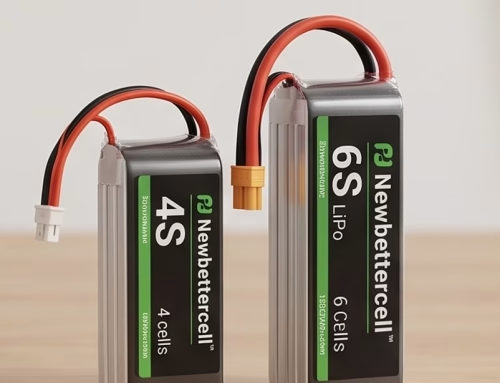
To power these sophisticated systems, reliable energy is essential. As a leading manufacturer of high-performance power solutions, Newbattercell specializes in cutting-edge lithium-polymer battery technology. Our product lineup includes high-energy-density drone batteries for long-endurance missions and high-discharge-rate FPV batteries for racing.
For more information on high-quality drone power solutions, visit FPV Drone Battery. If you have any questions or need technical assistance regarding drone batteries, please feel free to contact us.