Drone Battery and Motor Relationship: How to Properly Match UAV Power Systems
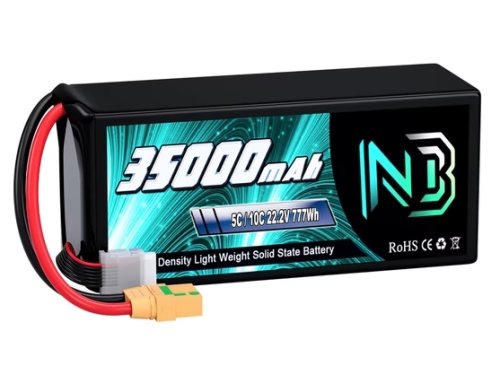
In a drone system, the battery and motor are two of the most critical components responsible for power supply and thrust generation. The battery stores and delivers electrical energy, while the motor converts this electrical power into mechanical thrust to enable takeoff, hovering, and flight control.
However, these components do not function independently. Instead, they form a highly interdependent power system, where each component directly affects the performance, efficiency, and safety of the other.
Understanding the interaction between drone batteries and motors is essential for engineers, drone manufacturers, and UAV system integrators when designing or selecting propulsion systems.
1. How Motor Specifications Determine Battery Configuration
Voltage Matching: Motor Voltage Determines Battery Cell Count
Drone motors operate within a specified voltage range, commonly including:
-
3S systems – 11.1V–12V
-
6S systems – 22.2V
-
12S systems – 44.4V
The battery voltage must match the motor’s recommended operating voltage.
Example:
If a motor requires 44.4V, a 12S lithium battery pack (3.7V × 12 cells) should be used.
Incorrect voltage selection can result in:
-
Motor startup failure
-
Reduced thrust output
-
Permanent motor damage
Current Demand: Motor Peak Current Determines Battery Discharge Capability
During high-power phases such as takeoff, acceleration, or heavy payload operation, motors draw significant current.
If the battery cannot deliver sufficient current due to an inadequate discharge rate (C-rating), several issues may occur:
-
Sudden voltage drop
-
Insufficient thrust
-
Battery overheating or swelling
The battery discharge capability should satisfy:
Battery Current Capability = Capacity × Discharge Rate
A 20% safety margin is generally recommended to ensure stable operation.
Motor Efficiency Influences Battery Capacity Requirements
High-efficiency motors require less electrical current for the same thrust output, which allows:
-
Smaller battery capacity
-
Reduced system weight
-
Improved energy efficiency
This results in longer flight times and better overall performance.

2. How Battery Specifications Limit Motor Performance
Battery Voltage Determines Motor Speed
The motor speed equation is:
Motor Speed = KV Value × Voltage
Where:
-
KV value = RPM per volt
-
Voltage = Battery output voltage
If voltage is too low:
-
Motor speed decreases
-
Thrust output becomes insufficient
If voltage is too high:
-
Motor overheating may occur
-
ESC stability can be compromised
Battery Discharge Rate Limits Motor Thrust Output
Even if a motor is capable of producing high thrust, insufficient battery power will prevent it from reaching full performance.
Example:
-
Motor maximum power: 500W
-
Battery maximum output: 300W
Result:
-
Reduced thrust output
-
Potential flight instability
Therefore, battery power capability must align with motor power requirements.
Battery Weight Influences Thrust Configuration
Increasing battery capacity improves endurance but also increases system weight.
If motors cannot provide sufficient thrust to lift the additional weight:
-
Flight efficiency decreases
-
Energy consumption increases
-
Total flight time may actually decrease
Proper system design must balance:
-
Battery capacity
-
Motor thrust capability
-
Total aircraft weight
3. Best Practices for Matching Drone Batteries and Motors
To achieve optimal propulsion system performance, engineers typically follow these steps:
Step 1: Define Mission Requirements
Determine key parameters such as:
-
Desired flight time
-
Payload weight
-
Operating environment
Step 2: Select Motor and Propeller Combination
Motor selection should consider:
-
KV value
-
Maximum current
-
Recommended voltage
-
Propeller size and efficiency
Step 3: Select Compatible Battery Specifications
Choose batteries with:
-
Correct voltage configuration
-
Adequate discharge capability
-
Sufficient capacity for mission duration
Step 4: Evaluate Overall System Efficiency
Analyze:
-
Battery weight
-
Motor thrust capability
-
ESC specifications
This ensures there are no performance bottlenecks.
Step 5: Maintain Safety Margins
Recommended engineering margins:
-
Battery discharge capability ≥ required current × 1.2
-
Motor thrust ≥ total drone weight × 2–2.5
These margins improve reliability and flight safety.
4. Power System Requirements for Different Drone Applications
| Application Type | Motor Characteristics | Battery Configuration | Matching Recommendation |
|---|---|---|---|
| Aerial Photography Drones | Stable low KV, low noise | High capacity, moderate discharge rate | Prioritize endurance and balance |
| Industrial Agricultural Drones | High torque, strong thrust | High voltage, high discharge rate, high capacity | Balance power and endurance |
| FPV Racing Drones | High KV, strong instant response | Low capacity, high discharge battery | Focus on explosive power and maneuverability |
| Surveying / Inspection Drones | High-efficiency cruising motor | Li-ion battery, high capacity | Pursue maximum flight endurance |
Different applications require different optimization strategies for battery and motor pairing.
5. Future Trends in Drone Battery and Motor Technology
High-Voltage Power Systems
Future UAV systems increasingly adopt 18S or 20S high-voltage architectures to reduce current losses and improve efficiency.
Smart Battery Systems
Modern smart batteries can monitor:
-
Voltage
-
Current
-
Temperature
-
Battery health status
This significantly improves operational safety and predictive maintenance.
Integrated Motor and ESC Designs
Combining ESC and motor modules helps:
-
Reduce system weight
-
Simplify wiring
-
Improve response time
Advanced Battery Materials and Thermal Management
New battery chemistries and cooling technologies are enabling:
-
Higher energy density
-
Better heat dissipation
-
Higher power output capability
Conclusion
Drone batteries and motors form a closely coupled propulsion system, rather than a simple supply-and-consumption relationship.
Proper matching between these components ensures:
-
Optimal flight performance
-
Longer endurance
-
Improved operational safety
When designing or selecting UAV power systems, engineers must carefully balance voltage, current, thrust, weight, efficiency, and safety margins.
Newbettercell specializes in the integrated research, development, and manufacturing of drone batteries, providing reliable power solutions for modern UAV systems.
For more information about high-performance drone batteries, please feel free to contact our team or consult our technical experts online.