Customized Shaped Batteries in Medical Devices: A Deep Dive into Technology, Applications, and Future Trends
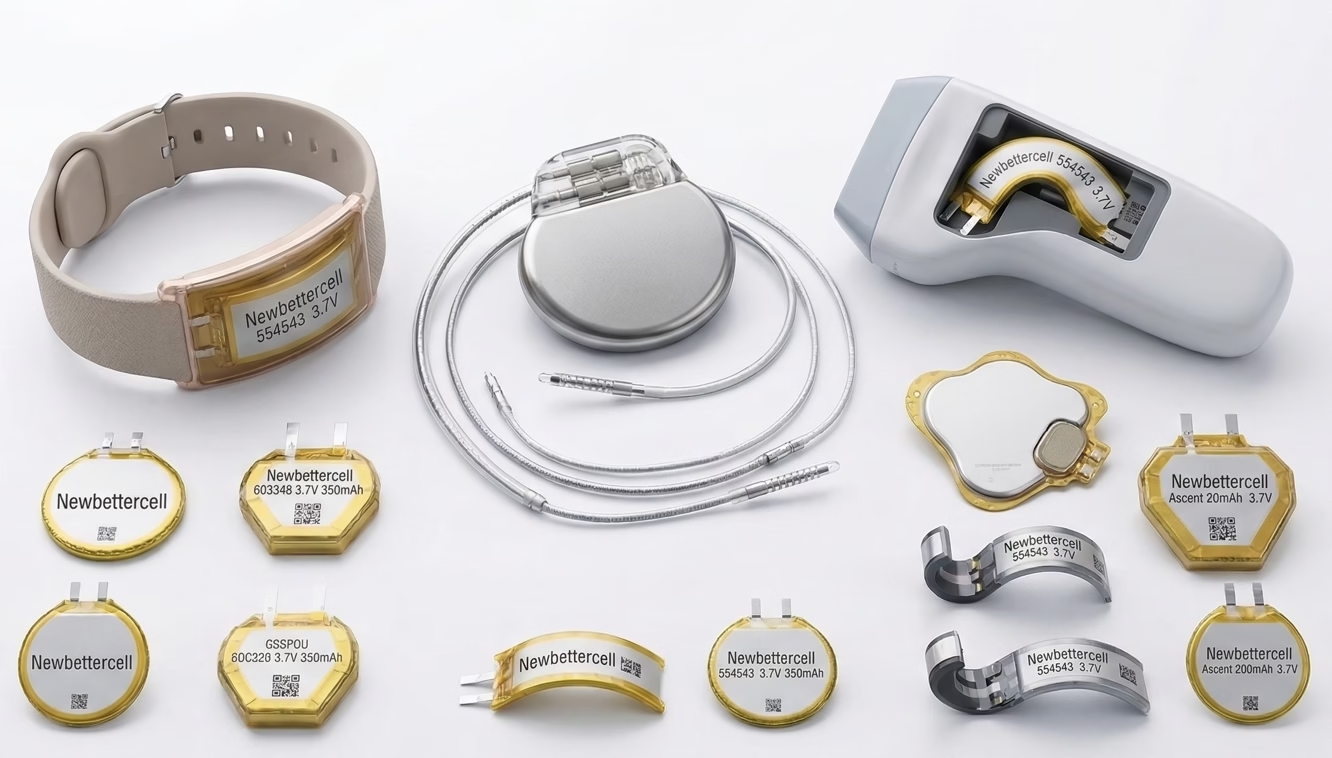
Medical technology is undergoing a profound transformation. The industry’s center of gravity is shifting from traditional, large, static equipment toward miniaturized, portable, wearable, and even implantable devices. This evolution presents unprecedented challenges for the power core—the battery—in terms of size, form factor, and performance. The emergence of shaped, customizable batteries is no longer merely a substitute for traditional cells; it is a key enabling technology for design breakthroughs, functional integration, and the enhancement of patient experiences.
This report systematically outlines the core considerations for battery selection in medical devices, analyzes the inherent logic behind the rise of shaped batteries, and interprets the rigorous technical standards they must meet. The value of a shaped battery lies not only in its physical adaptability but also in the advanced materials, precision manufacturing, and intelligent management systems that collectively resolve the fundamental contradictions between safety, reliability, and miniaturization in medical devices.
I. Core Selection Criteria and General Standards for Medical Batteries
1.1 Safety and Regulatory Compliance: The Non-Negotiable Red Line
Safety is the paramount consideration in medical power supply design; any failure can directly endanger patient lives. Therefore, battery integration must strictly adhere to international regulatory standards.
First, IEC 60601-1 is the globally recognized benchmark for the basic safety and essential performance of medical electrical equipment. Crucially, IEC 62133 (the safety standard for rechargeable cells and batteries) is often a prerequisite for a device to achieve overall IEC 60601-1 certification. This mandatory requirement creates a rigorous oversight system: if the battery fails to meet IEC 62133, the entire medical product cannot pass electrical safety certification, effectively blocking market entry.
Furthermore, the U.S. FDA imposes specific requirements for lithium batteries used in medical devices, such as production in UL-certified facilities and full traceability for every unit to allow for deep-dive analysis in the event of a failure.
1.2 Performance and Reliability: Determining the Device Life Cycle
The reliability of a battery directly impacts therapeutic efficacy. Energy density determines runtime between charges, while power density dictates instantaneous supply capacity for high-load applications like emergency resuscitators. For implantable devices, such as pacemakers, batteries require ultra-long service lives and extremely low self-discharge rates to avoid frequent surgical replacements.
Notably, advanced lithium batteries typically feature a flat discharge curve. While this provides a stable voltage supply for DC-DC converters to operate at peak efficiency, it challenges traditional fuel gauging. Estimating the State of Charge (SOC) and State of Health (SOH) becomes difficult because the voltage drop is minimal during discharge. To solve this, sophisticated Battery Management Systems (BMS) with sub-millivolt measurement precision are required to prevent overcharging (which leads to chemical degradation or fire hazards) and over-discharging (which severely shortens lifespan).
1.3 Comparative Analysis of Battery Chemistries
-
Lithium Metal Batteries: Including LiMnO2 and LiFeS2. They offer double the capacity of alkaline batteries in similar form factors and are ideal for continuous glucose monitors (CGMs) and defibrillators, though they require specific handling for leak prevention.
-
Silver Oxide Batteries: With a flat discharge curve at 1.55V, these are excellent for digital applications. Their silver coating can also reduce infection risks in implantable devices.
-
Zinc-Air Batteries: High energy density and economical, but since they require oxygen to function, they are limited to non-sealed devices like hearing aids.
Customized Shaped Batteries in Medical Devices: A Deep Dive into Technology, Applications, and Future Trends
Medical technology is undergoing a profound transformation. The industry’s center of gravity is shifting from traditional, large, static equipment toward miniaturized, portable, wearable, and even implantable devices. This evolution presents unprecedented challenges for the power core—the battery—in terms of size, form factor, and performance. The emergence of shaped, customizable batteries is no longer merely a substitute for traditional cells; it is a key enabling technology for design breakthroughs, functional integration, and the enhancement of patient experiences.
This report systematically outlines the core considerations for battery selection in medical devices, analyzes the inherent logic behind the rise of shaped batteries, and interprets the rigorous technical standards they must meet. The value of a shaped battery lies not only in its physical adaptability but also in the advanced materials, precision manufacturing, and intelligent management systems that collectively resolve the fundamental contradictions between safety, reliability, and miniaturization in medical devices.
II. The Rise of Shaped Batteries: Why “Non-Standard” is the New Standard
2.1 Enabling Miniaturization and Lightweight Design
Standard cylindrical or prismatic batteries severely limit the creativity of designers aiming for compact, ergonomic devices. In wearables and implants, internal spaces are often irregular. Shaped customizable batteries maximize these “dead zones,” allowing for a significant reduction in overall device footprint.
2.2 Enhancing User Experience and Design Freedom
A shaped battery allows a device to transition from a “medical tool” to a “lifestyle aid.” For instance, the latest generation of cochlear implant sound processors has achieved a 25% reduction in size and a 24% reduction in weight through optimized internal component arrangement. This thin, discreet design improves comfort for long-term users, particularly children. Similarly, ECG chest patches require ultra-thin power sources to ensure “invisible” wearability during daily activities.
2.3 Expanding Functional Boundaries
The space saved by a shaped battery can be repurposed for advanced functional modules. Instead of a bulky standard battery, a custom-fitted cell allows for the integration of Bluetooth modules, advanced sensors, or high-speed data processing chips, enabling remote monitoring and real-time analytics.
III. Technical Requirements and Characteristics of Shaped Batteries
3.1 Superior Performance Metrics
Shaped batteries must achieve higher standards than traditional cells. For example, some flexible lithium-ion secondary batteries can reach energy densities of 688 Wh/kg and power densities of 3200 W/kg, far exceeding standard industrial benchmarks.
3.2 Precise Management and Protection
The complexity of shaped batteries demands a more rigorous BMS. Beyond sub-millivolt precision for SOC estimation, the BMS must manage cell balancing. Differences in capacity or self-discharge rates can lead to imbalances. Active balancing (transferring charge between cells) or passive balancing (dissipating excess charge) is essential to maintain system safety and longevity.
3.3 Manufacturing Excellence and Quality Control
Manufacturing shaped micro-batteries is inherently complex. Reliability in this context refers to the “probability of the safety design being successfully realized.” Potential issues, such as excessive stress during electrode winding, can lead to internal short circuits over time. Therefore, advanced quality control, including CT scanning for non-destructive internal inspection, is vital to ensure long-term reliability.
IV. Typical Application Cases in Medical Devices
-
Implantable Devices: From cochlear implants to pacemakers. In defibrillators, batteries must provide powerful pulse currents (up to 0.4 A) within milliseconds while maintaining a stable potential.
-
Wearable & Continuous Monitoring: CGMs and ECG patches require lightweight, stable power. Designers often weigh the high specific energy of Lithium-Manganese (e.g., CR2032) against the flatter discharge curve of Silver Oxide based on the device’s specific voltage requirements.
-
Portable Emergency Equipment: High-flow emergency aspirators require rugged, high-power batteries. Meanwhile, hospital transport tablets utilize hot-swappable battery designs to ensure uninterrupted data flow during critical patient transfers.
Conclusion and Outlook
Shaped customizable batteries are the inevitable result of the trend toward miniaturized, intelligent, and human-centric medical devices. Looking ahead, we expect to see further integration of technologies like biofuel cells, which could potentially power implants using the body’s own glucose, eliminating the need for surgical battery replacements.
Why Partner with Newbettercell?
Newbettercell has been a leader in the R&D and production of shaped batteries for over 20 years, maintaining long-term partnerships with globally renowned medical brands. We are industry pioneers in the smart ring battery sector and hold multiple patents for curved and ultra-thin battery products.
In the medical device industry, Newbettercell masters advanced manufacturing processes that meet the most rigorous demands: high voltage, high discharge rates, fast charging, and exceptional stability. Beyond standard 4.2V polymers, we provide mass production for high-voltage 4.35V and 4.4V shaped batteries. Our customized medical battery solutions are backed by a comprehensive certification system and the highest safety standards, providing reliable support for your next-generation medical innovations.
| Standard / Requirement | Scope of Application | Relevance to Batteries |
|---|---|---|
| IEC 60601-1 | Medical Electrical Equipment | Mandatory basic safety and performance standard. Requires that batteries inside the equipment comply with specific standards. |
| IEC 62133 | Rechargeable single cells and battery packs | Safety standard for rechargeable batteries. It is a prerequisite for the equipment to pass IEC 60601-1 certification. |
| IEC 60086-4/5 | Primary batteries (non-rechargeable) | IEC 60601-1 requires that non-rechargeable batteries must comply with this standard. |
| UL 2054 | Household and commercial batteries for medical use | Applied batteries must also comply with this standard. |
| FDA Requirements | Medical lithium batteries | Requires production in a UL-certified factory, and each battery must be traceable for failure analysis. |