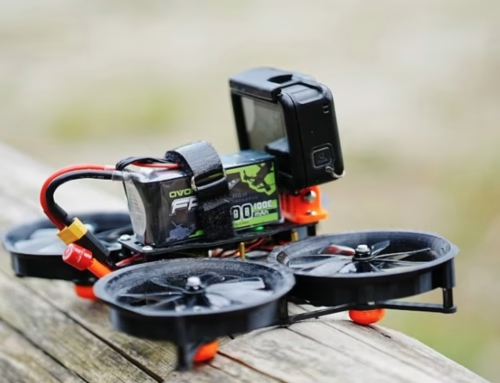
Gravity is a constant. It does not care about your marketing hype or your desire for an eight-minute flight time on a five-inch freestyle rig. If you think slapping a massive 1550mAh brick on top of a 5-inch frame is the solution to short sessions, you are fundamentally misunderstanding the physics of flight. You are building a flying truck. It will fly like one. It will wallow in corners, it will scream in propwash, and it will punish your motors. Every gram you add to that frame has a tax. We call it the aerodynamic tax, and most of you are overpaying.
The Physics of Disc Loading and Why Your Quad Feels Like a Wet Sponge
Disc loading is the ratio of your drone’s weight to the total area of its propeller discs. High disc loading means your motors have to spin faster just to maintain a hover. When you increase the weight by choosing a heavy, low-density battery, you are pushing those motors higher into their thrust curve. And here is the kicker: motors are not linear. They get less efficient the harder they work. You think that extra 200mAh is giving you more time. But because the motors are now pulling more current just to fight the extra weight, you are actually burning through that capacity faster. It is a cycle of diminishing returns. And it ruins the feel of the sticks.
But it gets worse. We need to talk about the Moment of Inertia (MOI). This is the resistance of an object to changes in its rotation. In FPV, your battery is the single heaviest component. If that mass is distributed poorly, or if it is simply too heavy, your flight controller has to work overtime. When you command a snap roll, the motors have to exert massive torque to get that weight moving. Then, they have to work even harder to stop it. This is where your mid-throttle oscillations and propwash come from. Your PID loop is fighting physics, and physics usually wins. A lighter battery with higher energy density reduces the MOI, allowing for those crisp, robotic stops that separate a professional pilot from a hobbyist struggling with a heavy rig.
The Momentum Trap: Why ‘Heavy’ Isn’t Always ‘Stable’
Some pilots argue that a heavier quad carries momentum better through gaps. They are right, but for the wrong reasons. A heavy quad is harder to deflect, but it is also harder to recover. If you miss your line with a 750g AUW (All-Up Weight) beast, you are hitting the concrete. A lighter quad, powered by something like a ZGBattery 1300mAh high-density pack, allows you to change direction instantly. You want agility, not just mass. Because mass without control is just a projectile. And projectiles don’t win races or look good in freestyle edits.
ZGBattery Chemistry: It Is Not Magic, It Is Materials Science
Most pilots think all LiPos are the same. They are wrong. Most manufacturers use standard-grade lithium cobalt oxide and thick substrate separators because they are cheap and easy to manufacture. ZGBattery does not do that. We focus on the Energy Density Equation. This means packing more milliamp-hours into a smaller physical footprint without increasing the weight. How? We use higher-grade raw materials and a proprietary folding process. This allows us to use thinner internal separators. Thinner separators mean we can fit more layers of active material into the same cell volume.
And we do not stop at the chemistry. We look at the internal resistance (IR). High IR is what causes voltage sag. When you punch the throttle, the battery heats up because energy is being lost as heat instead of being sent to the ESCs. By using purer raw materials and optimizing the cell tab connections, we keep the IR low. This means you get the full punch of the battery from the start of the pack to the end. You get the capacity you paid for, and you get it in a package that doesn’t weigh down your frame like a lead anchor.
Understanding the Internal Resistance (IR) Ceiling
Low IR is the holy grail for freestyle. When you are deep in a power loop and need that burst to clear a ledge, you cannot afford for your voltage to drop to 3.2V per cell. That sag is a symptom of poor energy density and high internal resistance. Because ZGBattery uses thinner, more efficient separators, the ions can move faster between the anode and cathode. This is direct-drive power. No fluff. No marketing gimmicks. Just physics-backed performance that keeps your throttle linear and your maneuvers predictable.
The Capacity Guide: Choosing Your Weapon
Stop buying the same battery for every build. Your 5-inch freestyle rig has different needs than your long-range cruiser or your bando basher. You need to match the battery to the mission profile. If you are a shop buyer, you need to understand this so you can actually advise your customers instead of just shifting boxes.
1000mAh 6S: The Surgeon’s Tool
This is for the ultra-light builds. If your dry frame weight is under 380g, this is your battery. It provides the highest power-to-weight ratio possible. The quad will feel like it is connected to your brain. Every tiny movement of the gimbal is reflected in the air. You will lose about 45 seconds of flight time compared to a 1300mAh, but the agility you gain is worth it. This is for technical park flying and tight gaps where precision is everything.
1300mAh 6S: The Golden Standard
This is the sweet spot for 90% of freestyle pilots. It offers the perfect balance of momentum and agility. It has enough mass to help you throw the quad over a building in a flick, but it is light enough that you can still catch it without the motors screaming. At ZGBattery, our 1300mAh packs are designed to weigh what others’ 1100mAh packs weigh. That is the energy density advantage. It is the pack you reach for when you don’t know what the spot looks like.
1500mAh 6S: The Heavy Hitter
Use this for cinematic setups or if you are doing aggressive bando bashing where you need the extra weight to carry through the air. But be warned: you are sacrificing agility. This is for the pilots who want to stay in the air longer and aren’t doing technical, high-speed snap rolls. If you are a B2B buyer, stock these for the cinematic crowd and the beginners who haven’t learned to manage their throttle yet.
Weight Distribution: The Top-Mount vs. Bottom-Mount Debate
Where you put the battery matters as much as how much it weighs. Physics dictates that the closer the mass is to the center of thrust (the prop line), the more stable the roll axis will be. Top-mounting the battery puts that heavy mass right in line with the props. This creates a more neutral feel. Bottom-mounting the battery creates a pendulum effect. It is great for stable, straight-line speed, but it makes the quad want to ‘swing’ out of tight turns. If you are flying freestyle, top-mount your ZGBattery packs. Period. Don’t fight the physics of your own frame.
Why Frame Designers Hate Your Battery Straps
We spend hundreds of hours designing frames with 5mm chamfered carbon and titanium hardware to save 10 grams. Then a pilot comes along and uses two heavy rubberized straps and a 1550mAh battery. It’s insulting. Every gram counts. Use high-quality, slim straps. Keep your battery centered. If your battery is shifted 5mm forward or backward, your motors have to work unevenly just to stay level. That is wasted energy. That is heat. That is inefficiency. Align your battery with the center of gravity (CoG) and let the flight controller do its job without fighting an unbalanced load.
The B2B Advantage: Why Energy Density Sells
If you are running a drone shop, you are the gatekeeper of performance. Pilots come to you when their quads fly like garbage. Usually, it is because they are over-propped or over-weighted. By stocking the full ZGBattery high-density line, you are offering a solution to the weight problem. You aren’t just selling a battery; you are selling a performance upgrade. A pilot who switches from a standard 1300mAh to a ZGBattery 1300mAh will feel the difference in the first turn. They will come back for more. Because performance is addictive.
And let’s talk about reliability. High energy density doesn’t mean fragile. Our cells are wrapped in high-impact PVC and feature reinforced leads. We know these packs are going to hit concrete. We know they are going to be pushed to 100 amps on a punch-out. We build them to survive the bando, not just the test bench. Stocking a range of capacities allows you to cater to the micro-long-range guys, the hardcore freestyle pilots, and the cinematic pros all with one brand.
FAQ
Q1: Why does my quad fly worse with a 1500mAh battery compared to a 1300mAh?
Answer: Moment of inertia. You added 30-40 grams of dead weight right at the center of gravity. Your motors now have to work harder to stop a flip, causing propwash and sloppy handling.
Q2: How does ZGBattery make their packs lighter without faking the capacity?
Answer: Cell chemistry. We use a proprietary high-density folding process with thinner internal separators and purer raw materials. You get true capacity in a smaller physical volume.
Q3: What is the ideal AUW (All-Up Weight) for a modern 5-inch freestyle quad?
Answer: Around 600g to 650g with the battery and GoPro included. If you push past 720g, you are flying a cinematic truck, not a freestyle scalpel.
Q4: Is a 1000mAh 6S battery too small for aggressive freestyle?
Answer: No. If your dry frame weight is under 380g, a 1000mAh 6S ZGBattery is a weapon. It gives you hyper-responsive throttle feel, though you will sacrifice about 45 seconds of flight time.
Q5: Do lighter high-density batteries suffer from worse voltage sag?
Answer: Typically, yes, cheap ones do. But ZGBattery counters this by lowering the internal resistance (IR) of the cell tabs, allowing rapid discharge without the thermal spike that causes sag.
Q6: Does top-mounting vs bottom-mounting the battery change agility?
Answer: Absolutely. Top-mounting puts the mass closer to the propeller line, creating a tighter roll axis. Bottom mounting acts like a pendulum, which is great for stable cruising but terrible for snap rolls.
Q7: Why should B2B distributors stock all three capacities?
Answer: Because pilots build for different spots. A bando basher buys the 1300mAh for momentum. A park flyer buys the 1000mAh for agility. Stocking the full ZGBattery high-density line captures the entire freestyle market.
Stop bolting dead weight to your carbon fiber frames. You spend a fortune on the best motors and the lowest-latency links, then you ruin it all with a battery that belongs in a power tool, not a high-performance aircraft. Physics is the only judge that matters in the air. If you want to win the fight against gravity, you need to optimize your energy density. Find your perfect weight-to-power ratio at ZGBattery today and start flying the quad you actually built, not the brick you’ve been settling for.