Technical Explanation: How to Choose Batteries for FPV Racing Drones? The Matching Logic from Propellers to Motors to Batteries
The flight performance and safety of FPV drones fundamentally come down to the precise synergy of a sophisticated power system. In the power chain of “propellers — motors — ESCs — batteries,” the battery serves as the final link in energy delivery. Its parameters directly determine the drone’s burst power, flight endurance, and overall stability.
Starting from a system-matching perspective, this guide from Newbettercell breaks down the core essentials of battery selection to help you build an efficient and reliable flight setup.
1. The Underlying Logic of the Power System: The Battery Is the “Final Link” in Performance Delivery
FPV drone power delivery follows a strict hierarchical logic: Propellers define the load through size and pitch → Motors respond to RPM demands via KV rating → ESCs regulate current output → The battery must match the entire system’s peak power requirements.
If the battery underperforms (e.g., inflated C-rating claims or insufficient capacity headroom), even top-tier propellers, motors, and ESCs will suffer from voltage sag, blackouts, or even “fried” components. Therefore, battery selection must start by back-calculating from the system’s origin — the propellers and motors.

2.Reverse-Engineering Parameters: Precise Matching from Propellers and Motors to Battery
-
Propellers: Load Size Sets the Current Baseline
Impact of size and pitch:
- 5-inch props (e.g., 5045, 5149): Mainstream for freestyle and racing — moderate load, requiring batteries that balance burst power and endurance.
- 6-inch props (e.g., 6045, 6145): For long-range or high-altitude cruising — heavier load, demanding higher capacity and C-rating from the battery.
Key logic: Larger props create higher instantaneous peak current when driven by the motor, so the battery needs a higher discharge C-rating to support it.
-
Motors: KV Value and Current Demand in Dynamic Balance
- High KV (>2300): Preferred for racing setups — strong burst but high power consumption; pair with high C-rating batteries (120C+).
- Medium KV (1900–2300): Balanced freestyle motors; match with medium C-rating batteries (90–120C) for a good mix of power and flight time.
- Low KV (1300–1700): For long-range or heavy-lift builds; smoother current draw — extend flight time by increasing capacity (e.g., 1600mAh+).
-
ESCs: The “Hard Limit” on Battery Discharge Capability
The ESC’s maximum current rating sets the minimum discharge requirement for the battery. For a typical quad (4 motors): Single ESC 35A × 4 motors = theoretical max instantaneous current of 140A.
Battery continuous discharge must satisfy: Capacity (Ah) × C-rating ≥ Total ESC current × 1.2 (safety margin).
Example: A 6S 1300mAh (1.3Ah) 120C battery delivers 1.3 × 120 = 156A continuous, comfortably covering a 140A ESC system with headroom.
3.Core Battery Parameters: Three-Dimensional Matching of Voltage, Capacity, and C-Rating
-
Voltage (S Count): The “Voltage Benchmark” of the Power System
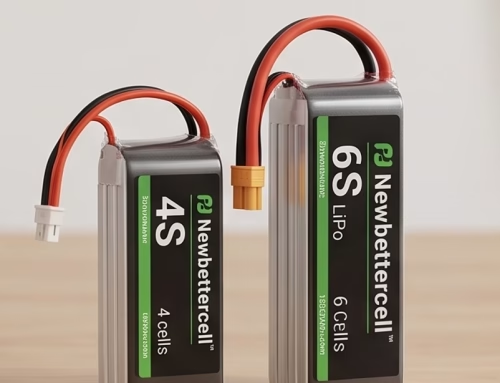
- 4S (14.8V): Beginner-friendly — lower voltage, smoother flight feel, ideal for learning basic control.
- 6S (22.2V): Standard for racing and freestyle — higher voltage unlocks more power for aggressive flying.
- 7S–8S: Niche for long-range builds; requires low-KV motors and large props, with extremely high demands on cell consistency.
Recommendation: Choose based on ESC and motor voltage compatibility. Prioritize 6S for racing/freestyle; consider 4S + low KV for longer endurance.
-
Capacity (mAh): The Trade-Off Between Endurance and Agility
- 5-inch freestyle: 1300–1550mAh (6S) — balances ~4–5 minutes of flight time with all-up weight ≤550g.
- 6-inch long-range: 1500–2000mAh (6S) — extends flight to 6–8 minutes; watch overall weight distribution.
- Racing setups: 850–1300mAh (6S) — extreme lightweight (e.g., ~120g for 1000mAh) for sharper turns and acceleration.
-
Discharge C-Rating: The Key to Preventing Voltage Sag
- Freestyle: ≥90C — handles frequent throttle punches and tricks.
- Racing: ≥120C — supports sustained high current in top-speed runs (e.g., peaks >100A).
- Long-range: ≥70C — prioritizes stable output over extreme bursts.
Pitfall warning: Beware of small brands inflating C-ratings. Stick to reputable names like Tattu, CNHL, GNB — their real-world discharge performance is far more reliable.
-
Size & Weight: Fitment Determines the Flight Feel
- Space fit: Measure your battery compartment to avoid issues (e.g., 5-inch frames usually ≤38mm wide).
- Weight balance: Coordinate battery weight with frame and components to prevent nose- or tail-heavy setups that affect flight controller stability. For lightweight builds, opt for aluminum-plastic soft-pack batteries (e.g., Tattu R-Line series) for strength without excess mass.
4.Real-World Selection Tips: Scene-Specific Battery Recommendations
- Daily Freestyle Flying Needs: Agile control + moderate endurance + crash resistance. Recommended: Tattu R-Line 6S 1300mAh 120C Advantages: 120C handles instant power spikes, 1300mAh gives ~4.5 minutes flight time, rugged aluminum casing for impact protection.
- High-Speed Racing Needs: Maximum burst + lightweight + low internal resistance. Recommended: Tattu R-Line 5.0 150C 1480mAh Advantages: 150C ultra-fast discharge, 1480mAh weighs ~237g — paired with 5-inch racing props can hit 200km/h+ speeds.
- Long-Endurance Cruising / Cinematic Needs: Maximum flight time + stable output + environmental resilience. Recommended: Tattu HV 6S 1600mAh 70C Advantages: High-voltage cells (4.35V full charge) boost energy density, 1600mAh delivers 7+ minutes, 70C ensures steady long-duration performance.
5. Usage & Maintenance: Key Details to Maximize Battery Life
- Numbering & Tracking: Assign each battery a unique ID; log cycle count, voltage drop, etc., to monitor degradation accurately.
- Voltage Management: Avoid deep discharge (keep cell voltage ≥3.5V); charge promptly after flights; store long-term at 40%–60% charge.
- Balance Charging: Use a smart charger for regular cell balancing to maintain voltage consistency and prevent single-cell failure from ruining the pack.
Conclusion
| Dimension | What does it determine for the battery? | How to match / select |
|---|---|---|
| Propeller size | Current load | Larger prop → requires higher C rating |
| Motor KV | RPM & current spikes / burst | Higher KV → bigger burst current → needs higher C rating |
| ESC current rating | Peak current demand | ESC current × 1.2 ≤ Battery max continuous discharge current |
| Flight purpose | Capacity vs weight tradeoff | Racing = light & high C Training = balanced & stable Cinematic/long range = high capacity & longer flight time |
| Total AUW (All-up weight) | Upper limit of battery weight | Keep total takeoff weight under control / within desired range |
Choosing an FPV drone battery is never an isolated decision — it’s a deep understanding and precise matching of the entire power chain. From propeller load to motor KV, from ESC current to battery C-rating, every element must interlock perfectly. Only by applying system-level thinking and adapting flexibly to real flying scenarios can your FPV drone unleash peak performance in the sky while ensuring safety and longevity.